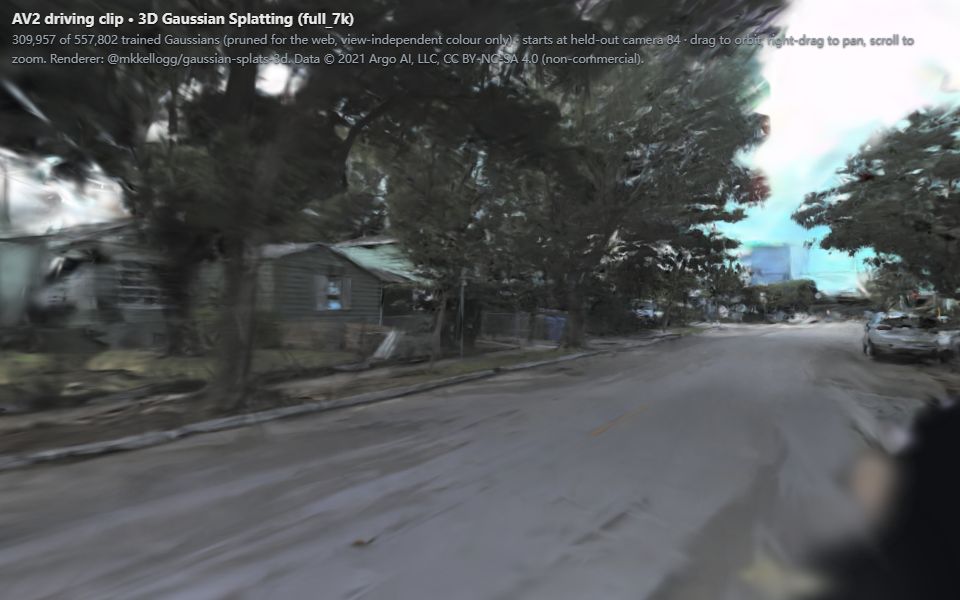
From a reconstruction experiment to an inspectable scene.
A small driving scene with reproducible offline evaluation and a browser viewer whose download, preparation, reset and resource lifetime can be inspected.
A research export is only useful to a visitor if it loads reliably and its limits remain clear. This single eight-second Argoverse 2 clip pairs archived experiments with a separate, lightweight public viewer.
Implementation decisions
01
Keep evaluation provenance visible
Deterministic held-out frames, image and depth baselines, strict sensor-input separation and archived ablations make the experiment inspectable. The original all-scan initialization is retained and labelled for its depth-evaluation leakage.
02
Own decoded bytes and lifetime
HTTP compression can make the encoded Content-Length smaller than the decoded scene. The viewer loads a checked decoded buffer, holds its object URL until preparation finishes, then releases it. Returning to preview removes the renderer frame.
03
Let visitors choose the resource cost
A recorded preview loads first. The scene and renderer load only after Explore in 3D. Download and preparation have distinct states; ready users can move, reset and return to the preview.
Inspect it yourself
The public page contains an actual interactive 3D scene. Open the viewer, choose Explore in 3D, drag the scene, reset the view, return to the preview and load it again.
Load the 309,957-Gaussian, 9.9 MB export from the recorded preview.
Move the camera, reset it and release the renderer by returning to preview.
Read the source inventory and archived measurements alongside the rendering limits.